Showing posts with label expat diary. Show all posts

Tuesday, April 10, 2012

Shocking Saigon: What People Carry on Their Bikes

Beer crates, fridges, TV sets, a dog, three dogs, sleeping babies, huge potted flowers, sleeping toddlers, panes of glass, pipes, sleeping teenagers, piles of instant soup packs, one hundred balloons, water jugs, 3 more family members, tens of egg cartons:


themselves (sleeping):


and, sometimes, ...

Photo: (c) Ilie Boboc.

Saturday, August 20, 2011

House Maintenance Costs in Saigon


We've been here for 6 weeks now and we've just got our first maintenance bills. So, how much would a couple pay for a 4-BRM house in Binh Thanh? Well, not much at all:

Electric (metered) - $23 (480,000 VND)

Water (metered) - $3.7 (75,900 VND)

Internet - $13.3 (275,000 VND)

Cable - $4 (80,000 VND)

Garbage - $1 (20,000 VND)

Totals - $45 (931,000 VND)

Having a maid is something common and equally inexpensive. Our maid comes once a week and we pay her $1.7 (35,000 VND) /hour. She also pays all our bills whenever we are not at home when the utilities guys come to collect.

Sunday, July 31, 2011

Who Cures and Cares about Your Pet in Saigon?

(c) Cheryl Traiger; Burt Cureton.


Hera is the loveliest and the most-behaved dog I have ever seen. She even loves clams and cucumbers! But it seems Vietnamese food played a trick on her today. However, the vet at Saigon Pet came to the rescue. Here is a message from Cheryl and Burt, Hera's parents:

"We were about to feed Hera her dinner when she threw up and pooped on the stairs, then just collapsed and wouldn't/couldn't move. I had investigated vets before we moved here, so had the number of Saigon Pet Clinic handy. Many people had written nice things about the vet there - Nguyễn Văn Nghĩa DVM, PhD. I called the cell phone number listed on the site, the vet answered and said he would meet us at the clinic in 15 minutes. We became especially worried when we took out her travel bag and she didn't move - we had to put her in it. We jumped in a cab, and when we got to the clinic the vet and 2 assistants were already there. They ran out to meet the cab, grabbed Hera in her bag and took her right away to be examined. Based on his exam, he did blood work and started her on an IV, saying she was hypoglycemic. After a short time, she looked much better and he left the IV in her, gave her a shot and we had a chance to chat. He gave us lots of good advice on things we should be careful of in Vietnam and the specific potential health problems faced by dogs here. He studied in the UK, his English is amazing and the love he and his staff have for animals couldn't be more obvious. We are so grateful to have found him. Hera's a bit traumatized by the whole experience, but she was jumping around to get in her bag by the time we left."

http://www.saigonpet.com/index.php?lang=en

Foreign TV Channel Coverage in Vietnam

If you are afraid a TV would be useless in your house in Vietnam because there could be no foreign channels or because of their dubbing in Vietnamese, there's good news for you. Foreign TV channel coverage is pretty good:

(c) Paul Townsend. Source: Flickr.

Australia Network

DW Asia

NNK World

Channel News Asia

AXN – subtitled

KBS World

TV5 Monde Asie

Animal Planet

Discovery Channel

National Geographic

Fashion TV

CNBC

[v]Tunes

HBO

Star Movies

Star World

Star Sports

ESPN

True Sport

VBC

Max Cinemax

Tuesday, July 26, 2011

Saigon Sky and Summer Weather


Before coming to Saigon, everybody warned us about the weather here. "It's so hot and humid in Ho Chi Minh City, it's like a sauna!" Yes, it's humid, but nothing to worry about. We are in the middle of the rainy season, and I swear to God it doesn't rain more than once a day. It rains heavily, but the temperature doesn't exceed 30°C. And it even cools down in the evenings and we need to cover ourselves with some sheets at night. When I think about summers in Europe, I realize they are much more unbearable that the Vietnamese summer in the South. It's 38°C and very dry in Romania as I write - so I am really happy I can spend the summer here. As someone told me - it's a very nice place to be: no twisters, only honest rains!

Saturday, July 23, 2011

Columbia Asia Clinic

Columbia Asia Clinic - 08 Alexandre de Rhodes, District 1, HCMC

If you ever need to have a health check done (be it for the work permit or for any other reasons), this is the place to go as an expat. I am not snobbish, but my safety and health are not something to make jokes about. Of course I could have gone to a Vietnamese hospital, but I just can't image how I could have made myself understood there and how septic these places are. Probably they are, but the language barrier is a real problem, especially when health is involved.

Columbia Asia Clinic is located at 08 Alexandre de Rhodes St, in District 1 (a very posh location by the way!). The personnel speaks perfect English and are extremely friendly and helpful. And the place is spotless. A typical health check for a work permit in Vietnam consists of: blood tests (HIV), urine analysis, EKG (for those above 40), chest x-ray, medical history, and medical exam. The exam was really detailed and thorough, so I am very happy with this place and I will surely go there again after I receive my health insurance card.

As no health-check for the work-permit is covered by the insurance company, we had to pay 2,000,700 VND per person (more than twice the amount charged by the Vietnamese hospitals, eg:822,000 VND at Cho Ray Hospital: 201B Nguyen Chi Thanh, Ward 12, District 5). Appointments are strongly encouraged (phone: 848 3823 8455). The results are typically ready in 24 hours.

Friday, July 15, 2011

How to Lease A House in Saigon


Our house hunting started 6 months before we actually got to Saigon, the moment we found out we would go there. We were quite stressed because we had no idea about the Vietnamese real estate market. So we started to browse never-ending house listings and we began to figure it all out: serviced apartments - $400-$600/month, 1 BRM apartment - $500-$600, 2 BRM apartments or houses - $600-$800, luxury villas in residential compounds - $2,000 and more.

One month before leaving for Saigon, we contacted several realtors. Some of them answered and told us to call them when we'd be in the city, while others didn't answer at all. Out of those who did, the answer we got from Chum's House was the most encouraging, professional, and friendly at the same time. We provided Dang Van Tram with the information he needed (area, price range, type of housing), and agreed to meet as soon as we were in Saigon.

Everything happened as planned. We meet on July 4th at their office on Bui Vien (backpacker's area), visited 3 properties, and chose the last one - a 4-BRM traditional Vietnamese house next to the Zoo. Huyen, Thoa, and Phung- the three girls that work for Chum's House - assisted us through the whole process and negotiated with the landlord. They managed to convince her we should pay only 1-month deposit on signing the lease, and another 1-month deposit the moment we'd pay the rent for the second month. One typically has to pay a 2-month deposit on signing any lease and rumor has it the landlords will soon ask for 3-month deposits. Huyen also translated all discussions from English to Vietnamese and back and told us she would help us whenever we have communication problems with the landlord during our contract.

What you needed for signing a lease contract in Vietnam:

- passports;

- permanent address in Vietnam (this could be your work address);

- rent for the first month + 2-month deposit.

Our experience with Chum's House was excellent ad we do recommend them. Chum's House - 121/21 Bui Vien, Pham Ngu Lao, District 1, HCMC. Email: chum@chumshouse.com; Phone: 01699.727.306.

Other useful resources for finding a house in Ho Chi Minh City are listed here.

Thursday, July 14, 2011

Our Vietnamese House

We leased a typical Vietnamese house in Saigon and we are very happy with it. It's so large, it can accommodate at least four couples of friends at the same time. But I managed to clean and sort out only the 3rd floor (master bedroom, 2 bathrooms, kitchen, dining room) and the rooftop terrace today. A message to all our friends coming over: let us know your arrival date well in advance, so that we can clean the rest of the house in due course :D.


Tuesday, July 12, 2011

Shocking Saigon: Our First Street Food


Heavy rain today. We could not go out for dinner. So we bought food from the closest street side stall we could find. Two noodle dishes and 4 vegetarian hamburgers - $2. And again, that's probably expensive, who knows? 2 dollars, people, 2 dollars! And it was filling and gooood...

Shocking Saigon: Roosters on Bikes


[or, as Chris impudently riffed: Crowing Cocks on Motor Bikes! :)) ]

1. How many motorbikes are there in Ho Chi Minh City? Way too many. There's even one for each rooster in the city. And they are probably not afraid to use it. Beware!

2. How cheap is a haircut in Saigon? $1.3 - $1.5.  And that's expensive, because it's located in the backpacker's area.

(to be continued)

Wednesday, July 6, 2011

How to Open a Bank Account in Vietnam


We have recently opened a personal bank account at an international bank in Saigon. I was pretty skeptical regarding how smooth the whole process was going to be, but it proved to be pretty easy. What you need:

1. passport;

2. labor contract (that goes only for those who want a salary account; but any tourist can open an account associated to a ATM debit card - not need for labor contract);

3. proof of residential address in your home country - as we left our IDs at home, we used our police records translated into Vietnamese. But you can use you ID or driver's license as well.

If you want to transfer funds to another account in your home country, you have to make proof of their origin. Basically, you can transfer only your salary to an international account. Should the amount deposited in your account every month be higher than the amount specified in the labor contract, then you have to show the bank a proof of their origin, such as a pay slip.

In case your money comes from other sources, you won't be able to transfer it, but you can withdraw it from any ATM or spend it via a debit card. Opening an account is free. Debit cards are issued on the spot.

5 Things I love The Most about Saigon Today


I have been in Saigon for five days now and I know really well what my likes and dislikes are here. My top 5 likes about Saigon are:

1. food - the best cuisine I tested so far... by far! I am so happy I can also buy fresh fruit and juice from the street peddlers or from the market anytime for almost nothing.

2. people smiling all the time - we should learn that from them;

3. wi-fi in most cafes and restaurants and even in the most run down hotels. Quality is not exceptional, but it's good to have a wi-fi network when you need it.

4. things can be pretty cheap if you don't go shopping to the most luxurious stores or if you are good at bargaining with the sellers in the tourist area.

5. the coffee here is absolutely awesome - ca phe sua da has been my favorite of all.

Let's see how many others will add up to my list.

Friday, July 1, 2011

My (Phở)-rst Morning in Saigon

I literally could not open my eyes this morning. It's our first morning in Saigon. We are so damn tired after an almost 24-hour journey from Romania to Turkey and then Vietnam. But it is so all worth it!

My first full day in Saigon started brilliantly. Chris went downstairs to bring me some coffee and came back with a huge tray with phở (yeah!), omelet, fluffy baguette, bananas, and coffee. Phở is mind blowing: so many flavors - garlic, ginger, lemongrass, cilantro, shallots; I think this is going to be my addiction here.

If this means breakfast, I am very curious what dinner is all about. Only 10 hours to go :D.

[caption id="attachment_1227" align="aligncenter" width="640" caption="My craving for the past 6 months."][/caption]


[caption id="attachment_1229" align="aligncenter" width="640" caption="View from our room - De Tham St."][/caption]

Tuesday, June 21, 2011

Saigon to Have Travel Police


[caption id="attachment_1143" align="aligncenter" width="640" caption="Source: Flickr. (c) Patrick Donovan"][/caption]

LookAtVietnam reports that Ho Chi Minh City authorities have asked the Police to consider establishing a travel police office for the safety of tourists. The downtown area and the tourists sites are going to be safer.
The People’s Committees of districts were told to assign their police departments to combine with other forces to protect tourists. The Department of Transport is instructed to strictly control means of transport for tourists, especially taxies in the downtown area. The department will restructure bus stops in the downtown areas to serve tourists. As many tourists visiting Saigon have complained of having been cheated by taxi drivers, the HCM City Taxi Association will combine with the HCM City Department of Transport to supervise taxi service and punish cab drivers who break the rules and most often refuse to start meters.


Monday, June 20, 2011

Medical Insurance for Foreigners in Vietnam

I am lucky enough to get a pretty decent medical insurance with an important company in Vietnam. I suppose the name and amounts are confidential, so I will try to give you an idea about that without disclosing the figures per se.

The medical insurance policy covers in-patient and out-patient care for the insured. The policy provides coverage in Vietnam, with evacuation for essential emergency treatment to Singapore or Thailand. A policy providing the same coverage for family members may be purchased for an average of $1,000 per person per year. The actual amount depends on the age of the person insured.

Dental insurance is not included, but can also be purchased for $250 per person per year. However, emergency dental care, in case of accident, is covered in the medical insurance policy. There is no copayment for medical care, but there is one for services under the dental insurance plan.

Routine medical examinations, including general health checks, gynecological exams, inoculations, vaccinations and preventative medicines, eye and hearing tests and corrective surgery, and medical certificates and examinations for employment and travel are all excluded from coverage.  The same goes for preexisting conditions. However, if someone goes for a check-up and a disease is found, the insurer will pay for treatment of that disease. At the same time, there is a group of special diseases, including cancer, diabetes, heart disease, Parkinson’s disease that will not be covered during the first 12 months.

You may choose your hospital, medical center or clinic, but not a private doctor. If you go to a hospital, medical center or clinic in your insurer’s direct billing network, you will not have to pay at the time of service. The list below shows the most popular hospitals and clinics for foreigners in Saigon:

HOSPITALS

University Medical Center, 215 Hong Bang, Ward 12, District 5, Tel: (08) 38 554 269, Fax: (08) 39 506 126

HCM City Medical University Hospital (4th foundation), 243A Hoang Van Thu, P.1, Tan Binh District, Tel: (08) 38442.986, Fax: (08) 38443.429

Franco-Vietnamese Hospital, Add.: 6 Nguyen Luong Bang, Tan Phu Ward, District 7, Tel: (08) 34 113 333, Fax: (08) 34 113 453

Columbia Asia Gia Dinh Hospital, 01 No Trang Long, Binh Thanh District , Tel: (08) 38 030 678, Fax: (08) 38 030 677

Hong Duc Hospital, 32/2 Thong Nhat, Ward 10, Go Vap District , Tel: (08) 39969999, Fax: (08) 38959612

Trieu An Hospital,  425 Kinh Duong  Vuong,  An  Lac  Ward,  Binh Tan  District , Tel:  (08) 37 520 067, Fax: (08) 37 520 068

Hoan My Hospital, 124 Tran Quoc Thao, Ward 7, District 3, Tel: (08) 39 316 944 - (08) 39 312 514, Fax: (08) 39 311 940

Hoan My Hospital (2nd foundation), 4 Hoang Quoc Viet, Ward 1, Tan Binh District, Tel: (08) 38119.783

Phu Tho Hospital, 226 Doc Lap, Tan Quy Ward, Tan Phu District , Tel: (08) 38 109 518, Fax: (08) 38 109 513

Vu Anh International General Hospital, 15-16 Phan Van Tri, Ward 7, Go Vap District, Tel: (08) 39 894 989, Fax: (08) 39 897 209

An Sinh General Hospital, 10 Tran Huy Lieu, Ward 12, District 3, Tel: (08) 39 457 777, Fax: (08) 39 476 734

Saigon International Ob-Gyn. Hospital, 63 Bui Thi Xuan, Nguyen Cu Trinh Ward, District 1, Tel:  (08) 39253619, Fax: (08) 39253184

Saigon ENT Hospital, 1-3 Trinh Van Can, Cau Ong Lanh Ward, District 1, Tel: (08) 3 8213456, Fax: (08) 3 8210799

International Peripheral Neurology Hospital, 65A Luy Ban Bich, Tan Thoi Hòa Ward, Tan Phu District, Tel: (08) 39616 975, Fax: (08) 39616 978

CLINICS

Ho Chi Minh City Family Medical Practice, 34 Le Duan, Ben Nghe Ward, District 1, Tel: (08) 38 227 848, Fax: (08) 38 227 859

Columbia Asia – Sai Gon International Clinic,   08   Alexandre   de   Rhodes,   District   1, Tel : 848 3 8238455, Fax: 848 3 8238454

Victoria My My Clinic, 79 Dien Bien Phu, Da Kao Ward, District 1, Tel: (08) 39 104 545, Fax: (08) 39 103 334

Victoria My My Victoria Clinic, 135 Nguyen Van Troi , Phú Nhuận District,  Tel: (08) 3997 45 45, Fax: (08) 3997 99 79

Family Care International Clinic, 260 Nguyen Dinh Chieu, Ward 5, District 3, Tel: (08) 3 9 330 303, Fax: (08) 39 330 202

3-2 Dental Care Clinic, 74, 3-2 Street, Ward 12, District 10, Tel: (08) 3 8 627 991, Fax: (08) 3 8 658 571

Phoi Viet Respiratory Disease Treatment Centre, 20-22 Ngo Quyen, Ward 5, Dist 10, Tel: (08) 73088.999 or (08) 73066.777, Fax: (08) 73066.777

Viet Gia Medical Clinic, 166 Nguyen Van Thu, Đa Kao Ward, Dist 1, Tel: (08) 39118.485, Fax: (08) 39118.486

Friday, June 17, 2011

Bloggers on Pros and Cons of Living in Vietnam

1. The Fish Egg Tree - fisheggtree.blogspot.com


Adam Bray needs no introduction, but for those who don't know him yet, he is a travel writer, journalist and photographer with special interests in Vietnam, Cambodia, China, and New Zealand. Here are his comments on the pros and cons of living in Nam, as well as some recommendations on shopping and local customs: http://fisheggtree.blogspot.com/2007/07/thoughts-from-thorn-tree.html. Thank you, Adam!

2. Vietnam Oi! - caligarn.com


Minh is an American-Vietnamese living in Saigon. There is a very insightful posting on his blog on common Vietnamese behaviors that would annoy an average American. Minh has also made a personal list of 17 things one should love about this country and a list of 12 differences between California and Nam.

To be continued.

Featured photo credit: Charles Jeffrey Danoff (Source: Flickr)

Thursday, June 16, 2011

A Bureaucratic Saga: Working Abroad

Oooo-kay! I have just had my criminal record issued and much to my surprise it is clean! :) I had never asked for one before and I have to say I was a little bit nervous. Hold your horses, missy! If you think that you did your job when you defended you MA or PhD thesis, you’re wrong. This is only the beginning of a beautiful friendship with Vietnam and of a tiresome struggle with the academic and legal bureaucracy in my home country (Romania). I bet it’s the same for everybody.

What you have to do if you want to work in Vietnam:

1. get your criminal record: pay the criminal record fee at the post office, buy a 2 RON fiscal stamp, then go to the Police. They will issue the document on the spot. That’s easy.

2. take you highest diploma (the original copy of my MA diploma in my case) and have it legalized with the Ministry of Education. Make sure you also take the BA diploma, as well as your BA and MA school records, plus photocopies of all of them.

3. take your legalized diploma and criminal record and authenticate them with the Ministry of Foreign Affairs, as Vietnam didn’t sign the Hague Convention. So you won’t need an Apostille Certificate, but an authentication from the above-mentioned Ministry.

4. have your authenticated criminal record and your authenticated diploma translated into Vietnamese with a certified translator. These are really hard to find and very expensive. I paid almost 30 euro/page. Yap, that’s right!

5. authenticate the translations with the Ministry of Justice or with whoever authenticates certified translations and notarized documents in your home country.

6. repeat step 3 for all the translated documents.

7. take everything to the Vietnamese Embassy. They will authenticate (again!) everything.

8. the 7th step says: “authenticate your documents with the Vietnamese Ministry of Foreign Affairs”. I really don’t know what that means, but I will surely find out.

Then, you’re good to go! Don’t forget about the visa. :D

Saturday, May 7, 2011

10 Examples on How Inexpensive Vietnam Can Be

[caption id="attachment_748" align="aligncenter" width="640" caption="Fresh, cheap and delicious. (c) Shellfish. Source: Flickr."][/caption]

This is a reposting of a very insightful article of a fellow blogger: www.vietnam720.com. You will find out how cheap food, cigarettes, beer, eyeglasses, and other stuff can be.

http://www.vietnam720.com/travel-tips/10-examples-on-how-cheap-vietnam-can-be/

What to Bring and What to Leave at Home


[caption id="attachment_731" align="aligncenter" width="640" caption="That's a NO-NO! (c) flamingbear. Source: Flickr."][/caption]

Lists make me avoid chaos. This time, the Don't Bring That to Saigon list is more important than the other. Saigon is relatively inexpensive and unless you're high-maintenance and extremely picky you'll find everything you need there. What we found out online was quickly confirmed by our very helpful colleagues in Vietnam. We compiled our lists and theirs and this is the result: UBYMKRDVREG8
What to bring to Saigon:

1. Your passport, credit cards, documents + copies. My advice is to keep original copies in a safe at the bank. You don't know when you need them and it's safer that way.

2. Cash - a few dollar or euro bills - crisp, unmarked. ATMs are available, but the safest bet is to always have some cash on you.

3. Laptop and camera. Notebooks and laptops are somewhat more expensive in Vietnam. You can check prices online at the Apple store in Saigon.

4. A supply of regularly taken medication and your prescriptions.

5. Glasses, contact lenses and prescriptions.

6. Cosmetics you can't live without and sun protection.

7. Small gifts to give locals on various occasions - foreign gifts are much appreciated.

8. Lightweight and quick dry leisure clothes, suits, and shoes, especially if you have big feet (men >42/9.5, women >38/7.5) or wear extra-large apparel. Even many average-sized foreigners have a hard time fitting into pre-made local clothing. However, tailor-made clothes are readily available at very reasonable prices (<$150 for a custom-made suit, probably $20-$30 for a pair of pants, slightly less for a shirt, etc.).

9. spices you can't find here. It may sound awkward, but I will bring my stash of dried lovage and powder-borsch. :)

Optional:

1. Cell phone. Take your cell phone with you only if it's a tri-band one or if it's valuable to you. Otherwise, cell phones are readily available in Vietnam and really affordable. Most services utilize pre-pay, rechargeable sim cards. Minutes can be purchased at shops everywhere, and there are often specials by which you can double your minutes if you recharge on certain days.

2. Reading material. My advice is to buy the electronic version of the book or magazine (if available) and read it on your Kindle, iPad, or computer. Any kilo of luggage you can save matters.

3. Sheets and pillowcases (for queen size beds), as they can be expensive.

What not to bring to Saigon:

1. Appliances that don't operate at 220V.

2. Fine jewelery and other accessories.

3. Warm clothes. In case you travel to the North in the winter, you'll be able to find warmer clothes in Saigon. There is no use to overload your suitcases. Bring only one sweater/jacket.

4. CDs, DVDs, etc.

5. Food. One of the reasons for which you are blessed to be in Saigon is food. You have to try a new cuisine, learn new recipes, find out about a new culture and you have all the time in the world to go back to your oatmeal, hamburgers, or fish and chips. However, there are many international food stores and international restaurants in Saigon that cater for your homesickness.

6. Insect repellents. You'll need that only when traveling in forested areas, but they are available locally.

7. Film for conventional cameras.

8. Raincoats and umbrellas.

So, travel light!

Monday, March 14, 2011

Vietnamese New Year


The Tet (Tết Nguyên Đán - literally the first morning of the first day of a first lunar cycle, or, in short, Tết) is the most important festival for the Vietnamese people. This is the Vietnamese Lunar New Year and is celebrated in late January-early February, depending on the Lunar Calendar. Officially, this national public holiday lasts for three days. However, the practice set it as a 7 or 10-day celebration. For the Vietnamese, the first day of Tet is the first day of spring in the new year.

It is said that Tet is an all-in-one celebration, as it combines the spirit of Thanksgiving, Christmas, New Year's and everyone's birthday. Tet is a time for family reunions, and for paying respect to ancestors and the elders.

The Tet period can be divided into three distinctive spans of time:

1. Tất Niên (Before New Year's Eve) - Two weeks before the actual celebration, all Vietnamese start to cook and clean and decorate their homes. Everybody goes shopping for food, clothes, and decorations and wait for their relatives to come back home. Most Vietnamese working abroad or in other cities usually return to their families to worship their ancestor together. At the same time, there is the belief that all debts have to paid, just to make sure there are no old debts for the new year to come.

Everybody cooks holiday food. Seven days prior to Tet, each Vietnamese family offers a farewell ceremony for Ong Tao (the Kitchen God) to go up to Heaven Palace. His task is to make an annual report to the Jade Emperor of the family's affairs throughout the year.

2. Giao Thừa (New Year's Eve) - the first day of this celebration is reserved for the close family. Children wear new clothes and receive money in a red envelope from the elders. This is the most important token of good luck for the coming year. Moreover, all families are very careful about the first person to enter their house on this day. Wise, successful, and moral people are said to bring good luck to the household they visit. The act of being the fist one that enters a house on Tet is one of the most important rituals on this holiday, so that many house owners make sure they are the first to enter immediately after the clock strikes midnight.

3. Tân Niên (the New Year) - during the following days, the Vietnamese visit relative, friends, and teachers. They make donations to local Buddhist temples and also offer gifts to family, friends, and neighbors. The gifts they make typically consist of food and money, new clothes, peach branches (for expelling evil), cocks/chickens (wishing for good manners), new rice (wishing for being well-fed), rice wine in a gourd (wishing for a rich and comfortable life), bánh chưng (or bánh tét) and bánh dày, which symbolize sky and earth (for worshiping the ancestors), red things (red symbolizes happiness, luckiness, advantages) like watermelon, dogs (the bark – gâu gâu – sounds like the word giàu - richness in Vietnamese language), medicated oil (dầu in Vietnamese, also sounds similar to giàu). On the third day of Tet, when the Vietnamese ancestors are ready to depart, people prepare other extravagant send-off meals, but with dishes and wine that are different from those prepared on the previous days.

Tet foods - A small portion of each dish is then placed as an offering on the altar meant to welcome back the ancestors (ruoc ong ba).

1. whole chicken - it symbolizes abundance and prosperity and sits prominently on the worship altar, along with the flowers, candles and incense sticks.

2. caramelized garlic shrimp and a a traditional pork stew with hard-boiled eggs (thit kho dua). For dessert, they serve che khoai mon (sticky rice pudding with taro root) and fresh fruits, such as watermelon and tangerines.

3. Mam Ngu Qua - The "five-fruit tray" symbolizes the admiration and gratitude of the Vietnamese to Heaven and Earth and their ancestors and demonstrates their aspiration for a wholesome life.

4. Bánh chưng and bánh dầy - tightly packed sticky rice with meat or bean fillings wrapped in Dong (Phrynium placentarium) leaves or banana leaves.

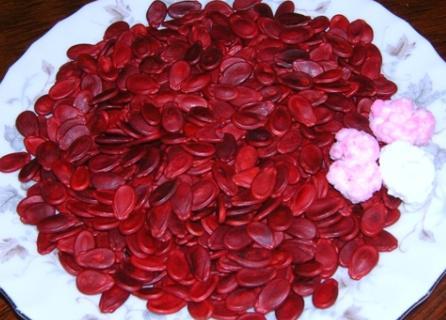
5. Hạt Dưa - roasted watermelon seeds.

6. Dưa Hành - pickled onion and pickled cabbage.

7. Củ Kiệu - pickled small leeks.

8. Mứt - dried candied fruits.

9. Cầu Dừa Đủ Xoài - popular fruits used for offerings at the family altar in fruit arranging art are the custard-apple/sugar-apple/soursop (mãng cầu), coconut (dừa), papaya (đu đủ), and mango (xoài), since they sound like "cầu vừa đủ xài" ([We] pray for enough [money] to spend) in the southern dialect of Vietnamese.

10. Thịt Kho Nước Dừa - meat stewed in coconut juice, a traditional dish of fatty pork stomach and medium boiled eggs stewed in a broth-like sauce made overnight of young coconut juice and nuoc mam (fish sauce). It is often eaten with pickled bean sprouts and chives, and white rice.

Decorations

It's a joy to be in Vietnam during Tet celebration. Streets are heavily decorated with flowers and fruits, while every family strive to adorn their home as appealing as possible.


Traditional decorations include cây nêu, an artificial New Year Tree consisting of a bamboo pole 5 to 6 m long. It is usually decorated with many objects, depending on the region, including good luck charms, origami fish, cactus branches, etc., hoa mai (Ochna integerrima), hoa đào (peach flower, in the northern part of Vietnam) or hoa ban (in the mountain areas). The kumquat tree is a popular decoration for the living room during Tết. Its many fruits symbolize the fertility and fruitfulness that the family hopes for in the coming year. Vietnamese people also decorate their homes with bonsai and flower plants such as chrysanthemum (hoa cúc), marigold (vạn thọ) symbolizing longevity, mào gà in Southern Vietnam and paperwhite flower (thủy tiên), lavender (viôlét), hoa bướm in Northern Vietnam. They also hung up Dong Ho Paintings and thư pháp (calligraphy pictures) around the house.

Chúc mừng năm mới!

"Mam Ngu Qua"


The "five-fruit tray" on the ancestral altar during the Tet Holidays symbolizes the admiration and gratitude of the Vietnamese to Heaven and Earth and their ancestors and demonstrates their aspiration for a life of plenty. The five fruits represent the quintessence hope that Heaven and Earth bless humans. It demonstrates a Vietnamese percept of life, "When taking fruit, you should think of the grower".